
The challenge.
In many organizations, people enter a sale more than once: in the sales tool, in the stock sheet and again in finance. Each copy drifts. Month end becomes the work of making the copies agree, and every report carries a footnote about which system it came from.
Every copy is a chance to be wrong. In an audit of 50 spreadsheets in everyday business use, 43 held at least one error that produced a wrong result.1
An ERP exists to end that. Running every department off a single database lets them share information directly.2 Firms that implemented an ERP were less likely to report weaknesses in their internal control over financial reporting than matched firms that had not.3
Even on an established ERP the habit returns when the system’s reports are not trusted. At one company, staff compared the ERP’s reports with their own spreadsheets, and when the two disagreed the spreadsheet won.4 At another, ten years after go-live, planning decisions were still made outside the system.5
The cost shows at month end. In the APQC benchmark of 2,300 organizations, the median takes 6.4 calendar days to close the books each month. The top quarter takes 4.8 days or less.6
The answer is one record, entered once and readable by everyone with the right to see it. What follows is how continON keeps it.
The approach.
We followed one sale through continON. We examined the sale type and its rules, the save that writes the ledger lines, the rights for each step, the general ledger and the financial reports. We checked each step against the code behind the screen.
What happened.
Five steps carry the sale from the sales floor to the reports.
The sale type carries the rules.
In continON, every sale uses a sale type. A person with the configuration right sets it up once in Sales Settings. The type fixes these settings.
| Setting | What it decides |
|---|---|
| Currency | The currency of the sale. |
| Price type | Which price applies: primary, wholesale or point of sale. |
| Ledger accounts | The debit and credit accounts the sale’s entries go to. |
| Warehouse | The warehouse the goods ship from. |
| Accounting and VAT | Whether the sale writes to the ledger, and how VAT applies. |
You add a new sale type, with its own accounts and warehouse, in Sales Settings. No code changes. That is where these rules belong. Configuration settings stay through patches and upgrades without rework. Code changes need maintenance with every release.7, 8 Custom code can bring real benefits. But compare each change with its maintenance cost.9
Saving the sale writes the ledger.
There is no separate posting step. When accounting is on for the sale type, a save of the sale lines writes a VAT line. The VAT line goes to the tax account of the VAT item. A save of a payment writes the debit and credit lines to the accounts of the sale type. It also writes a line to the account of the payment method. Each ledger line keeps the sale it came from.
| When | Ledger line | Account |
|---|---|---|
| A sale line is saved | VAT | The tax account of the line’s VAT item |
| A payment is saved | Debit and credit | The debit and credit accounts of the sale type |
| A payment is saved | Payment | The account of the payment method |
Because the accounts come from the sale type, nobody chooses them by hand at the moment of sale, and nobody re-keys the sale in Finance.
Who configures and who sells.
Configuring sale types and entering sales are separate rights in continON, and the Finance screens carry rights of their own.
| Who | What they do | Where |
|---|---|---|
| Administrator | Configures sale types: currency, price type, accounts, warehouse, VAT and accounting | Sales Settings |
| Sales staff | Enter the sale, its lines and its payments | Goods and Services |
| Finance staff | Read the general ledger and run the financial reports | Finance |
The separation matters as much as the accounts. COSO’s internal control framework builds segregation of duties into the control activities themselves, and asks for other controls where separation is not practical.10 A study examined 261 companies that disclosed material weaknesses after the Sarbanes-Oxley Act. The weaknesses usually involved revenue recognition, segregation of duties, period-end reporting and account reconciliation.11
Missing controls are where fraud gets in. The 2024 ACFE study examined 1,921 occupational fraud cases. In 32 percent, internal controls were missing. In 19 percent, someone overrode existing controls. The median case cost USD 145,000.12
Conflicts also creep in quietly. A 2024 audit of the ERP of one city found 128 users and 44 roles with at least one high-risk conflict. New users got the roles of the previous holder of the job.13 continON does not split rights by itself: an administrator decides who holds which, and continON keeps a change history of each create, edit and delete.
The ledger, read by account and period.
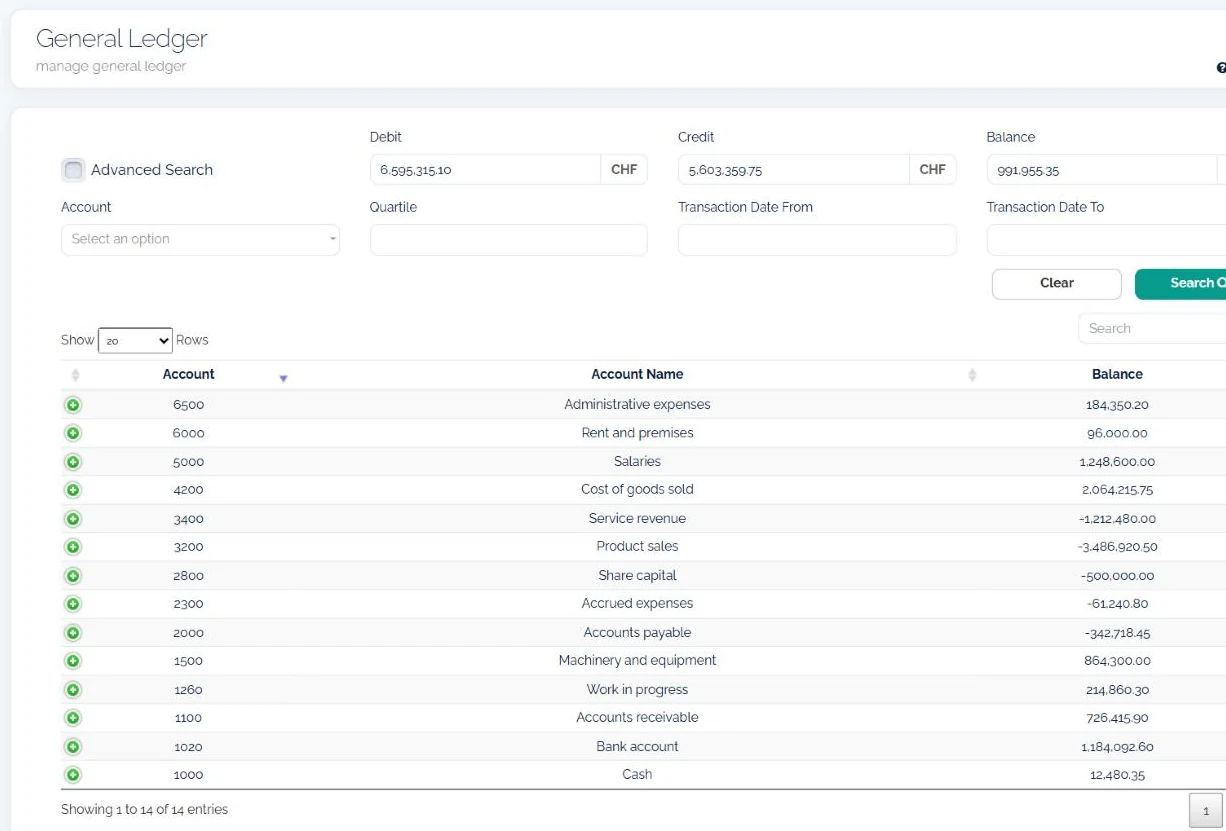
The general ledger shows the totals for debit, credit and balance, and each account with its balance. It filters by account, date range, subject, partner, currency, reference and organization unit. You can trace a figure in a report back to its entries.
Reports built from the same entries.
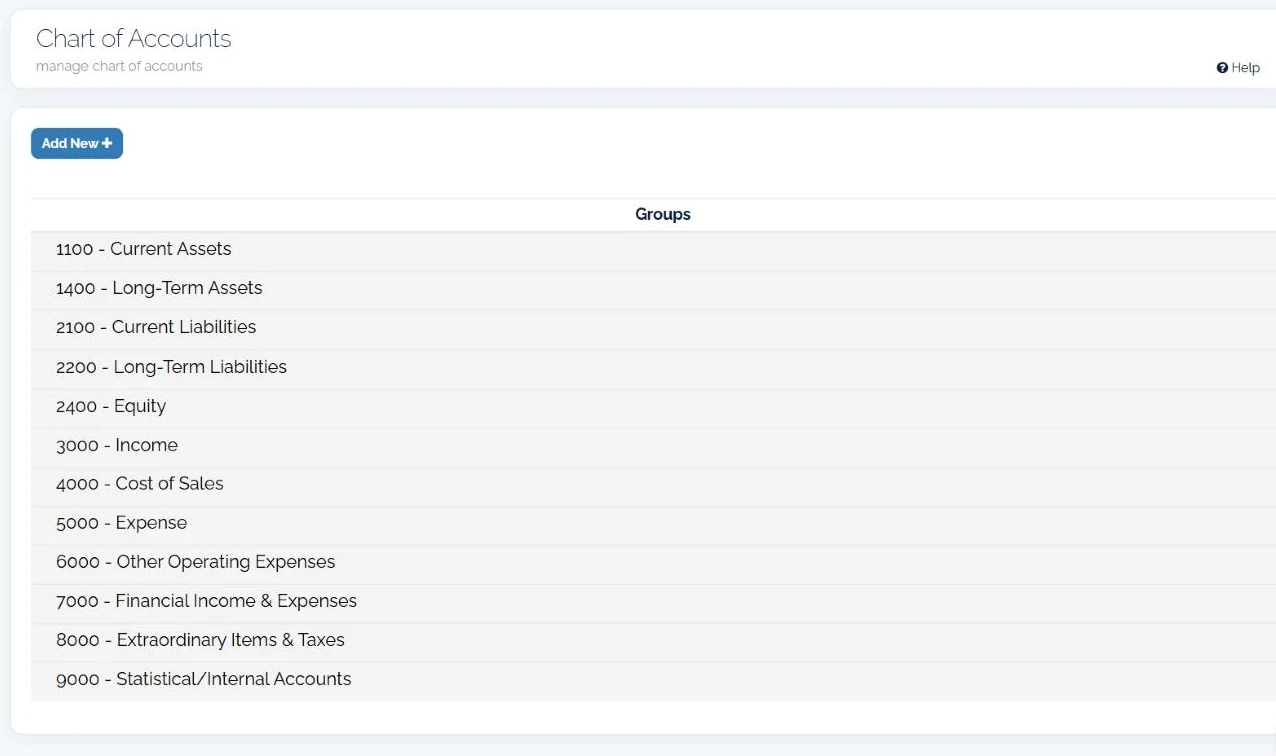
You build financial reports in the report designer from sections, components and formulas over the chart of accounts. Each report has its own currency. The income statement, the balance sheet and the cash flow statement are reports an organization configures this way, all reading the same ledger.
Reporting in more than one currency is ordinary under the accounting standards. IAS 21 separates the functional currency of an entity from its presentation currency. An entity can present its financial statements in any currency or currencies.14
Taxes, incoming and outgoing cash, payables and receivables and exchange rates sit in the same Finance application, against the same chart of accounts. This is most important in a complex business. Companies with several segments and foreign-currency operations disclose more material weaknesses in internal control.11
The result.
You set the rules once, in the sale type.
You configure currency, price type, accounts, warehouse, VAT and accounting in Sales Settings. Nobody selects an account at the time of the sale.
Saving writes the ledger.
With accounting on, the sale’s lines and payments write their own ledger lines, and nobody re-keys the sale in Finance.
Every report reads the same entries.
You configure financial reports from the chart of accounts, each in its own currency, over one ledger.
One record replaces the copies. You enter the sale once. Its accounts come from the configuration of its type, and every report uses the same entries.
Where AI comes in.
When a user asks about a sale, the continON assistant explains the sales form. Its instructions tell it not to assume stock movements, invoices or payment from a save alone. It does not see the organization’s sale types, so it cannot say which accounts a given sale will use. An ERP that explains itself sets out what it knows.
An AI can only explain what it can read in one place. When sales, stock and the ledger share one record, an assistant has one system to learn instead of three.
Lessons for ERP buyers.
Even a well-chosen ERP covers about 80 to 90 percent of the requirements of an organization. The decision depends on the remaining part.15
Five checks show whether a system keeps the thread from sale to statement.
- Is a sale entered once, with its accounts set by configuration?
- Are configuring the rules and entering sales separate rights?
- Does every ledger line keep the sale it came from?
- Can each financial report carry its own currency, from the same ledger?
- How much of the fit comes from configuration, and how much from changes to code?
Notes
- Powell, Baker and Lawson (2009). Errors in operational spreadsheets. Journal of Organizational and End User Computing 21(3): 24–36. Cited: p. 32. Read the source
- Loh and Koh (2004). Critical elements for a successful enterprise resource planning implementation in small- and medium-sized enterprises. International Journal of Production Research 42(17): 3433–3455. Cited: p. 3434.
- Morris (2011). The impact of enterprise resource planning (ERP) systems on the effectiveness of internal controls over financial reporting. Journal of Information Systems 25(1): 129–157. Read the source
- Kouki, Pellerin and Poulin (2007). Going beyond ERP implementation: an ERP assimilation cross-case analysis. CIRRELT working paper 2007-59. Cited: p. 10.
- Kouki, Pellerin and Poulin (2007). Going beyond ERP implementation: an ERP assimilation cross-case analysis. CIRRELT working paper 2007-59. Cited: p. 14.
- Wiggins (2018). Metric of the month: cycle time for monthly close. CFO.com, 5 March 2018. APQC Open Standards Benchmarking data. Read the source
- Ng (2001). A decision framework for enterprise resource planning maintenance and upgrade: a client perspective. Journal of Software Maintenance and Evolution: Research and Practice 13: 431–468. Cited: p. 439.
- Leyh. Tailoring of ERP systems. In Readings on Enterprise Resource Planning, chapter 6, pp. 74–83. Cited: p. 80.
- Light (2001). The maintenance implications of the customization of ERP software. Journal of Software Maintenance and Evolution: Research and Practice 13(6): 415–429. Read the source
- Committee of Sponsoring Organizations of the Treadway Commission (2013). Internal Control: Integrated Framework. Executive Summary. Cited: p. 4. Read the source
- Ge and McVay (2005). The disclosure of material weaknesses in internal control after the Sarbanes-Oxley Act. Accounting Horizons 19(3): 137–158. Cited: p. 137. Read the source
- Association of Certified Fraud Examiners (2024). Occupational Fraud 2024: A Report to the Nations. Key findings. Read the source
- City of College Station Internal Auditor’s Office (2024). Audit of segregation of duties within ERP role-based access. Report 24-04. Cited: pp. 3, 10. Read the source
- IFRS Foundation. IAS 21 The Effects of Changes in Foreign Exchange Rates. Read the source
- Leyh. Tailoring of ERP systems. In Readings on Enterprise Resource Planning, chapter 6, pp. 74–83. Cited: p. 75.